
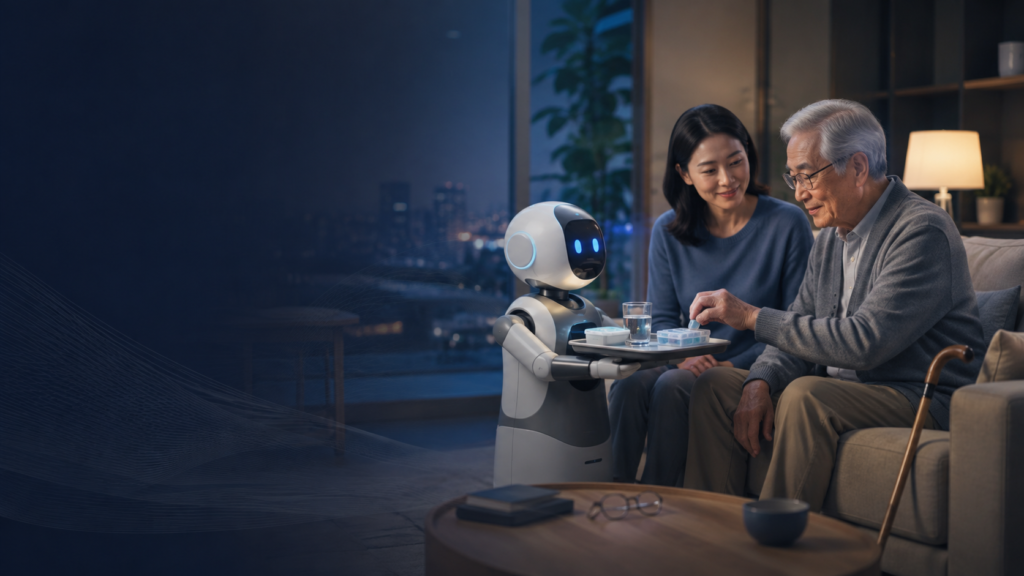
Most people who search for a robot for an elderly parent are not shopping for a gadget. They are worried about someone, they live too far away, and they are trying to work out whether any of this technology is real.
So this guide is written for you, the adult child, rather than for the person who will live with the robot. It covers what these machines genuinely do, what they emphatically do not do, and the conversation you need to have before one arrives in your parent’s living room. If you want a straight product ranking instead, our best AI companion robot guide covers the field.
Start with the need, not the robot
Almost every disappointing purchase in this category comes from buying a robot for the wrong problem. There are four distinct needs, and no single machine covers more than one well:
- Loneliness and daily structure — someone living alone who goes days without conversation.
- Dementia and agitation — someone who needs calm and comfort rather than conversation.
- Medication and appointment reminders — a memory scaffold, not a companion.
- Safety and falls — genuine emergency response.
Be honest with yourself about which one is actually keeping you up at night. If the answer is the fourth, stop reading and buy a medical alert system instead. No companion robot on the market is a fall detector or an emergency service, and treating one as though it were is the single most dangerous mistake in this category.
For loneliness: ElliQ
ElliQ, from Intuition Robotics, is the only machine here with meaningful independent evidence behind it, and that evidence is unusually good.
New York State’s Office for the Aging has run a state-funded ElliQ programme for several years. Its February 2026 project update reports that 834 older adults had joined through screening by county Area Agencies on Aging, with more than 3,500 applying. Among participants in the third programme year:
- 94% said they felt less lonely
- 97% reported feeling better overall
- 88% said ElliQ made a positive difference to their daily lives
- 79% felt more connected to the world around them
- Satisfaction averaged 4.6 out of 5
That is a state ageing agency reporting on its own programme rather than a manufacturer’s marketing claim, which is why it carries weight. Treat it as encouraging rather than conclusive — these are self-reported measures from people who volunteered for the programme, not a randomised trial.
ElliQ is deliberately not a humanoid and does not pretend to be a person. It is a small swivelling lamp-like body with a separate touchscreen, and it stays in one place. Critically, it is proactive: it starts conversations, suggests activities and checks in, rather than waiting to be asked. That difference is the whole product. A device that waits to be spoken to gets ignored within a fortnight.
Cost: around $250 up front plus roughly $40 per month, or about $30 per month paid annually. Budget for the subscription indefinitely — it is not optional, and the robot is not much use without it.
For dementia: Tombot Jennie — with a caveat
Tombot Jennie is a robotic Labrador puppy built specifically for dementia care, and it takes the opposite approach to ElliQ. It does not talk, and it does not walk. It responds to touch and sound with movement and vocalisations, and it was designed with Jim Henson’s Creature Shop to feel convincing to hold.
That design choice is deliberate and well judged. For someone with advanced dementia, a conversational device is confusing and often distressing. Something warm that responds to stroking is not.
The caveat matters more than the product. As of mid-2026 Jennie is still waitlist-only, with more than 19,000 people signed up and first shipments targeted for late 2026. Tombot has not published a final price — roughly $1,500 has been cited previously, but that is not a confirmed figure. Tombot is also pursuing FDA registration as a medical device, which would be a first for a robotic animal, but that process is not complete.
So: promising, evidence-informed, and not something you can buy today. If your parent needs comfort now, a Sony Aibo or a simpler robotic pet is available immediately, and plush robotic animals from other makers cost a fraction as much.
For presence without a subscription
If a monthly fee is unwelcome — and for many families it is the sticking point — the robotic pet route avoids it entirely.
Sony Aibo is the most sophisticated robotic dog available to consumers, recognises faces and develops behaviour over time. LOVOT is designed purely for attachment: it seeks warmth, asks to be picked up, and does nothing useful whatsoever, which is rather the point. DDL Vector 2.0 is a small desk companion at a much lower price.
None of these will remind anyone to take a tablet. They provide presence, not care.
What these robots genuinely cannot do
Worth stating plainly, because the marketing in this category is soft-focus and the gaps matter:
- They do not detect falls or summon emergency help. Buy a dedicated medical alert device for that — it is a different product category and it is not expensive.
- They do not administer or dispense medication. They can remind. Someone with genuine cognitive decline may still not take the tablet.
- They are not a substitute for human contact, and the honest research does not claim they are. The realistic framing is that they fill the long empty hours between visits, not that they replace the visits.
- They need Wi-Fi and power, and someone to troubleshoot both. If your parent cannot restart a router, budget for that falling to you.
- They can be rejected outright. A meaningful number of people simply do not want one, and that is a legitimate answer.
The privacy conversation, and who it is really for
These devices have microphones, most have cameras, and they are always listening for a wake word. The data goes to a company’s servers.
Before buying, read the operator’s policy on what is recorded, what is retained, and what family members can see remotely. Then ask yourself an uncomfortable question: is the monitoring feature for your parent’s benefit, or for your peace of mind? Both are valid reasons — but they are different reasons, and only one of them belongs to the person who has to live with the device.
The families who do this well tell the parent exactly what the robot can see and hear, and let them decide. The families who do it badly install a camera in someone’s home and describe it as a companion. That distinction will determine whether the thing is still switched on in six months.
What it costs against the alternatives
ElliQ at roughly $250 plus $40 a month works out near $730 in year one and about $480 a year after.
For comparison, professional in-home care in most of the US runs $25 to $35 an hour, so a single weekly two-hour visit costs several thousand dollars a year. A companion robot is not a replacement for that care, but as a supplement covering the hours nobody is there, the arithmetic is genuinely favourable — and that is the honest case for the category.
Compare specifications across the models we track in AI companions and pet robots, or line two up directly with our comparison tool.
The verdict
If the problem is loneliness in someone who is cognitively well and lives alone, ElliQ is the evidence-backed choice, and the New York State data is the most credible thing in this whole category.
If the problem is dementia, Tombot Jennie is the product built for it — but join the waitlist and buy a robotic pet in the meantime rather than waiting on an unconfirmed ship date.
If the problem is safety, buy a medical alert system today and consider a companion robot as a separate, later decision.
And whichever you choose, ask your parent first. A robot that arrives as a surprise usually ends up in a cupboard.
For a wider view of how this technology is being used day to day, see How AI companions are changing everyday life.