
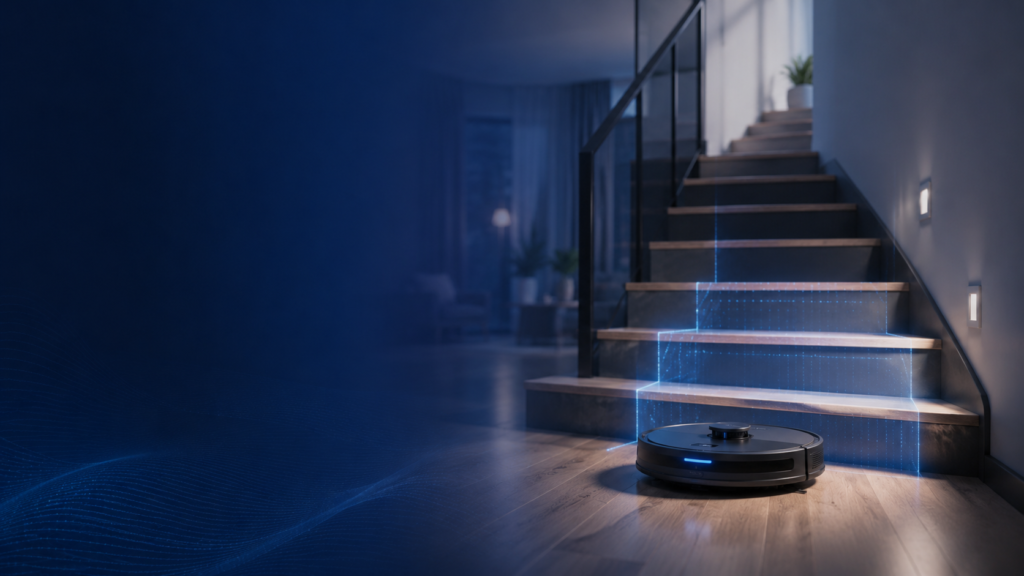
The short answer, before you read any further: no robot vacuum you can buy today climbs a flight of stairs. Not one. If a page tells you otherwise, it is describing a CES demo, a threshold-crossing chassis, or a product that does not have a release date.
That is worth saying plainly, because this is one of the most misleadingly answered questions in home robotics. What follows is what was actually demonstrated in 2026, what genuinely ships, and what to do if you have a two-storey house and are tired of carrying a robot upstairs.
What Roborock showed at CES 2026
The machine driving all of this attention is the Roborock Saros Rover, announced at CES in January 2026 as the first robot vacuum built on a wheel-leg architecture. It has articulated legs on wheels, and the demonstrations were genuinely impressive: it climbed steps, stabilised itself when struck with tennis balls, and handled obstacles that would strand any conventional robot.
It is also, as of August 2026, not on sale. Roborock has announced no retail date. Estimates put it somewhere around $2,000 to $2,600 when it does arrive, but that is an estimate rather than a price.
So the Saros Rover is real — a product in development rather than vapourware — but it is not a purchase decision you can make this year. Treat every “best stair-climbing robot vacuum” listicle that ranks it accordingly.
Why stairs are so much harder than they look
It is reasonable to wonder why this is taking so long when legged robots have been jumping and backflipping in research videos for a decade. The gap is not ambition, it is the constraints a domestic vacuum has to work inside.
A robot vacuum carries a dustbin, a water tank, mop hardware and a battery, and it has to stay slim enough to fit under a sofa. Legs add height, and height is the one dimension the product cannot afford. A machine tall enough to walk confidently is a machine that no longer cleans under furniture, which is most of the reason people buy one.
Then there is failure cost. A legged robot that misjudges a step does not simply stop — it falls down a staircase, possibly onto a pet or a child, carrying a litre of dirty mop water. Every conventional robot vacuum already has cliff sensors whose entire job is to refuse to go near a drop. Building a machine that deliberately overrides that instinct, safely, every time, in a dark hallway, is a far harder safety problem than making it climb at all.
Add the battery cost of lifting the whole machine repeatedly, and the reason the industry solved thresholds first becomes obvious. Thresholds are 90% of the practical benefit for a fraction of the risk.
What you can actually buy: chassis that climb, not legs
The meaningful 2026 advance is not legs. It is chassis lift, and it ships today.
The Roborock Saros 20 sells for $1,599.99, pairs 36,000 Pa of suction with the AdaptiLift Chassis 3.0, and is quoted by Roborock as offering a 3.46-inch double-layer lift for crossing thresholds. That will not get it upstairs. It will get it over the raised doorway strips, bathroom lips and thick rug edges that strand most robots and generate most “my vacuum is stuck again” complaints.
For the overwhelming majority of homes, that is the problem worth solving. Stair climbing is the fantasy; thresholds are the daily reality.
Among the models we track, the flagship class handles thresholds and multi-floor mapping well. The Roborock S8 MaxV Ultra, Dreame X40 Ultra and ECOVACS DEEBOT X5 Omni all store maps for several floors, so the robot knows where it is when you move it. If you want to understand how that mapping works, we cover it in SLAM explained.
The robotic arm is real — and it works about half the time
The other CES headline was robots with arms. Unlike the legs, this one you can already buy.
The Roborock Saros Z70 carries a five-axis OmniGrip arm and 22,000 Pa of suction. It launched at $2,599.99. Roborock’s own store now lists it at $1,699.99, and retailers have discounted it to around $1,300 — one of the more dramatic price falls in the category.
Here is the part the launch coverage skipped: independent reviewers put the arm’s success rate at roughly 50% on socks and small toys. It identifies the object, reaches, grips, and about half the time it works.
Whether that is remarkable or useless depends entirely on your expectations. As an early look at where cleaning robots are heading, it is genuinely exciting. As a solution to a child’s bedroom floor, a coin flip is not a feature. Buy the Z70 for its cleaning, which is excellent, and treat the arm as a bonus rather than the reason.
Dreame’s claw, and a date that keeps moving
Dreame’s Cyber 10 Ultra takes a different approach — an arm that extends from the top of the robot with a claw that lifts objects up to about 500 grams, roughly a pound. It also climbs steps of up to 6 cm, around 2.4 inches, which is threshold territory rather than staircase territory.
It has now been shown at IFA 2025 and again at CES 2026. Dreame has targeted August 2026 at around €1,799, roughly $2,000, but no firm release date has been confirmed. A product that has been demonstrated at two consecutive trade shows without shipping deserves patience rather than a pre-order.
What actually works for a multi-floor home
If your real problem is two or three floors, here is the honest advice, and it is not what the marketing suggests.
Buy two cheaper robots instead of one flagship. Two solid mid-range machines, one living permanently on each floor, cost less than a single flagship and eliminate carrying entirely. Each keeps its own map, each has its own dock, and neither has to be moved. The Roborock Q Revo MaxV, eufy Clean X10 Pro Omni and Narwal Freo X Ultra all sit in that band.
If you would rather have one machine, buy a flagship with reliable multi-floor mapping and accept that you will carry it. The iRobot Roomba j9+ and SwitchBot S10 both handle stored floor plans well.
What you should not do is wait for a stair-climbing robot to solve it. Even once the Saros Rover ships, a first-generation legged machine at flagship-plus pricing will be a worse cleaner than a mature robot at half the price.
So should you wait?
No — with one narrow exception.
Wait only if you specifically want to own the first legged robot vacuum and the money is not the point. That is a legitimate reason, and it is roughly the same reason people buy first-generation anything.
Everyone else should buy now. The 2026 flagships clean better than the 2025 ones by a modest margin, prices on last year’s models have fallen sharply, and the genuinely new capabilities — legs, claws — are either unavailable or work half the time. Compare current models in the robot vacuums category, or line two up with our comparison tool.
Not sure which specification actually matters? Start with our robot vacuum buyer’s guide, or see the current rankings in the best robot vacuum of 2026.
The verdict
Stair-climbing robot vacuums exist as engineering, not as products. The Saros Rover is real and undated. The arms are real and unreliable. The chassis lift is real, shipping, and quietly the most useful thing to come out of CES 2026.
Buy for thresholds, buy for suction, buy for a dock that empties itself. If you have stairs, buy two robots rather than waiting for one that can climb them.