
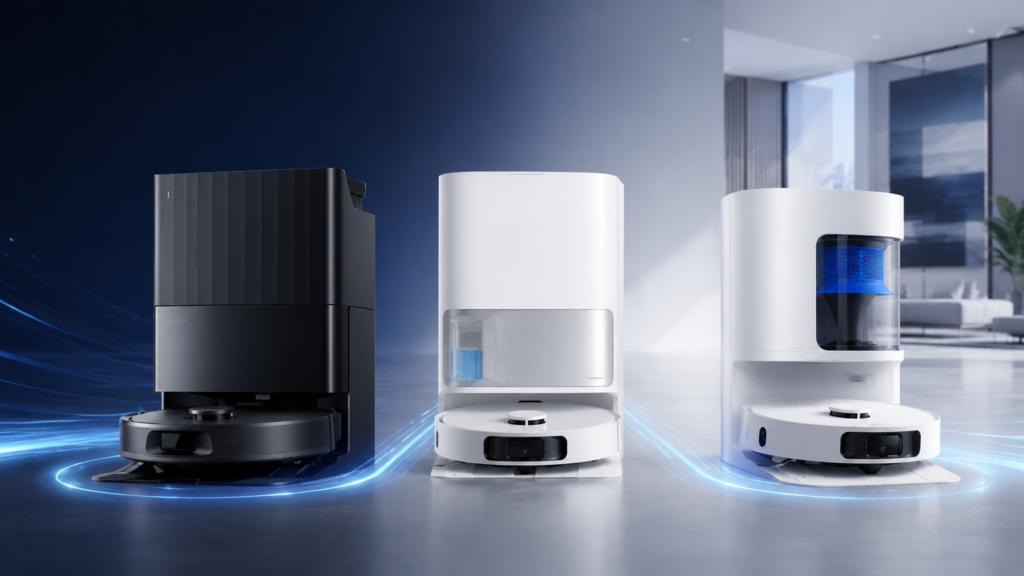
Three brands now dominate home robotics, and most buying guides treat them as interchangeable. They are not. They have genuinely different strategies, and the right one for you depends less on which has the highest suction number this quarter than on what you want the robot to do in three years.
Before any of that, one thing needs saying, because it is the assumption underneath most brand-loyalty advice.
The “ecosystem” is one app, not a system
The pitch is that buying into a brand gets you a connected fleet: your vacuum, your mower and your future robots all working together, sharing intelligence.
That is not what you get. What you get is one app instead of three.
A Dreame mower does not know anything useful about your floors because you own a Dreame vacuum. They do not share maps — an indoor floor plan and a lawn boundary have nothing meaningful in common. They do not coordinate schedules in any way that matters. The vacuum does not tell the mower it is raining.
One app is worth something. It is genuinely nicer than juggling three logins, and firmware updates arrive in one place. But it is a convenience feature, not a technology advantage, and it should not override buying the best machine in each category. If the best mower for your lawn is a different brand from the best vacuum for your floors, buy both and live with two apps.
With that cleared up, here is what actually separates the three.
Roborock — the engineering leader
Roborock ships the most advanced hardware, consistently, and charges for it.
The Saros 20 pairs 36,000 Pa with the AdaptiLift chassis that lifts the whole robot over thresholds. The Saros Z70 is the only robot vacuum with a working robotic arm you can actually buy. The Saros Rover, its legged prototype, was the most talked-about machine at CES 2026 even though it has no release date.
Roborock also moved into mowing, showing the RockNeo and RockMow lines at CES 2026. That is a genuine expansion rather than a badge exercise.
Buy Roborock if you want the best-engineered machine and the price is secondary. The S8 MaxV Ultra and Q Revo MaxV remain excellent buys now that newer flagships have pushed their prices down.
The catch: you pay a premium, and Roborock’s newest features tend to be first-generation. The Z70’s arm succeeds roughly half the time. Being first is not the same as being finished.
Dreame — the value challenger
Dreame’s strategy is to match the flagship spec at a lower price, and it works often enough to make them the default value recommendation.
The X40 Ultra competes directly with Roborock’s flagships and typically undercuts them. The L30 Ultra sits a tier below and is frequently the best pound-for-pound buy in the category.
Dreame is also the only one of the three whose mower we currently stock — the Roboticmower A1 — so if the single-app argument matters to you, Dreame is the most straightforward way to act on it today.
Buy Dreame if you want 90% of the flagship experience for meaningfully less money.
The catch: Dreame announces aggressively and ships slowly. Its Cyber 10 Ultra, the robot with a claw arm, has now been shown at IFA 2025 and CES 2026 with no confirmed release date. Judge Dreame on what is in stock, not on what was demonstrated.
Ecovacs — the one that does more than floors
Ecovacs has the broadest product range of the three and the longest history in the category.
The DEEBOT X5 Omni is its flagship, and the DEEBOT T30S Combo pairs a robot with a detachable stick vacuum — genuinely useful, and something neither rival offers in the same way.
Its GOAT mowers are the most interesting part of the range. They use AI cameras to distinguish grass from non-grass in real time and ride over passable edges for a true zero-edge cut, which is a different approach from the RTK-boundary method most rivals use.
Buy Ecovacs if you want breadth, or if the detachable stick vacuum solves a real problem in your home.
The catch: Ecovacs is rarely the outright performance leader in any single category, and its app has historically been the weakest of the three.
Head to head
| Roborock | Dreame | Ecovacs | |
|---|---|---|---|
| Strategy | Engineering leader | Value challenger | Breadth |
| Price position | Premium | Undercuts flagships | Mid to premium |
| Best for | Best hardware regardless of cost | Most performance per dollar | Range and unusual formats |
| Standout | Only buyable robotic arm | Flagship specs, lower price | Detachable stick vac; GOAT mowers |
| Weakness | Premium pricing; first-gen features | Announces faster than it ships | Rarely category leader; weaker app |
| Mower on site | Not yet | Yes | Not yet |
Browse each maker’s full range on our Roborock, Dreame and Ecovacs brand pages, or put two models side by side with the comparison tool.
What about iRobot?
Worth addressing, because iRobot invented this category and many people still start there.
iRobot no longer leads on specification. Its rivals ship higher suction, better mopping and more sophisticated docks at lower prices. What iRobot retains is navigation maturity, US support infrastructure and the Roomba j9+‘s genuinely reliable obstacle avoidance.
If you want the highest specification per dollar, the three brands above beat it. If you want a machine that behaves predictably and a support line in your own country, iRobot still has an argument.
The thing that actually predicts regret
None of the above is what makes people unhappy two years in. Suction figures do not age badly. Two other things do.
Consumables. Every one of these robots needs brushes, filters, mop pads and dust bags on a rolling basis, and the cost varies enormously between brands and models. Before buying, look up the replacement pack for the exact model and multiply by two or three years. It is occasionally a meaningful fraction of the purchase price, and it is the single most overlooked number in the category.
Software support. These are cloud-connected appliances. When a brand stops updating the app for an old model, features degrade quietly — a mapping feature stops working after a phone OS update, or the servers behind voice control are retired. This is where brand size genuinely matters, and it is an argument for all four names here over a cheaper machine from a maker you have not heard of.
Neither of these appears on a spec sheet, and both outlast the suction number you compared at purchase.
So which should you buy?
Buy the machine, not the brand. That is the honest conclusion, and it follows directly from the ecosystem point at the top: since the apps do not meaningfully cooperate, brand loyalty buys you very little.
If you want a single recommendation for each case:
- Best overall hardware — Roborock, and expect to pay for it.
- Best value — Dreame, on models that are actually in stock.
- Widest range and unusual formats — Ecovacs.
- Most predictable, best support — iRobot.
The one case where brand loyalty genuinely pays is if you are buying several robots at once and will be annoyed by multiple apps every week. That is a real preference, and Dreame currently makes it easiest to act on. It is just a much smaller advantage than the marketing implies.
For current model rankings see the best robot vacuum of 2026, or start with our robot vacuum buyer’s guide if you are still working out which specifications matter. If you are weighing the newest features, we cover what is real and what is a demo in robot vacuums that climb stairs.