A Pivotal Moment
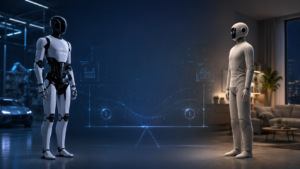
Humanoid robots have captured our imagination for decades through science fiction, but 2025-2026 marks a genuine inflection point. Companies like Tesla, Boston Dynamics, Figure AI, and Agility Robotics are making serious progress on robots that walk, talk, and manipulate objects in human environments.
But how close are we really to having a humanoid robot in your home? The honest answer is nuanced.
Where Humanoid Robots Excel Today
Warehouses and Manufacturing
The first real deployment wave is happening in industrial settings. Agility Robotics’ Digit is already working in Amazon warehouses, picking up and moving totes. Figure AI has partnered with BMW to deploy robots on manufacturing lines. These controlled environments are ideal because they are structured, predictable, and designed for efficiency.
Research and Healthcare
Universities and research hospitals are using humanoid platforms for rehabilitation therapy, human-robot interaction studies, and assistive care experiments. The human form factor makes these robots more intuitive for patients to interact with compared to industrial arms or wheeled platforms.
The Technology Gap
Despite impressive demos, several challenges remain before humanoid robots can function reliably in unstructured home environments:
- Manipulation dexterity: Picking up a box in a warehouse is straightforward. Loading a dishwasher, folding laundry, or cooking a meal requires fine motor control that current hardware struggles with.
- Battery life: Most humanoid robots run for 2-4 hours under active use. A home assistant would need to operate all day or charge quickly and unobtrusively.
- Cost: Current humanoid platforms cost $50,000-$150,000 to manufacture. Consumer pricing needs to reach $10,000-$20,000 to achieve mass adoption.
- Safety: A 70kg bipedal robot operating around children, pets, and elderly family members must be exceptionally safe. Fall prevention, force limiting, and emergency stop systems need to be bulletproof.
The Timeline
Based on current trajectories, most industry analysts expect limited commercial humanoid robots in structured business environments by 2027-2028, with early consumer models appearing around 2030-2032. These first consumer models will likely handle specific tasks like tidying, fetching items, and basic household chores rather than being general-purpose helpers.
The smartphone analogy is useful here. The first smartphones were expensive, limited, and clunky. Within a decade, they were indispensable. Humanoid robots may follow a similar arc, just on a longer timeline.
What It Means for Consumers
While you probably will not be buying a humanoid butler this year, the rapid pace of development means it is worth paying attention. The foundational technologies being refined now, including AI reasoning, dexterous manipulation, and efficient actuation, will define the home robots of the next decade.